JVC and Epson – supplied with full Australian warranties
Projector Tech
There are three types of projection technology on the market right now, with the best offerings coming from JVC and Epson in the $5K to $40K price range. Here is what matters when you choose one. The current models, prices and the order form are on the 4K & 8K Projectors page.
The three technologies and how they compare
D-ILA PROJECTOR TECHNOLOGY
For the most in-depth reviews on the new JVC projectors and other goodies, check out Roland’s website at Simple Home Cinema. Roland is Australia’s finest reviewer, hands down. You will not find more detailed reviews on these projectors anywhere on the planet.
Native 4K Precision. Exceptional Contrast. True Cinematic Depth.
Direct Drive Image Light Amplifier (D-ILA) is an advanced projection technology developed by JVC to deliver exceptional image precision, outstanding native contrast and highly detailed cinematic imagery.

D-ILA belongs to a specialised family of imaging technologies known as Liquid Crystal on Silicon (LCoS).
Unlike conventional transmissive liquid crystal imaging systems, D-ILA uses a reflective imaging architecture in which liquid crystal elements control light reflected from a silicon-based semiconductor surface. This sophisticated optical design combines the precision of liquid crystal image modulation with the advantages of a highly reflective imaging structure. The result is exceptionally smooth images, excellent pixel definition, impressive black-level performance and natural cinematic detail.
JVC has continually refined its proprietary D-ILA technology for more than 25 years, developing increasingly sophisticated imaging panels, optical assemblies and digital processing systems for premium home cinema projection.
ADVANCED THREE-CHIP REFLECTIVE IMAGING
At the heart of JVC's D-ILA projection system are three dedicated reflective liquid crystal imaging panels.
Light from the projector's illumination system is separated into its three primary colours: red, green and blue. Each colour is directed towards its own D-ILA imaging panel, where precisely controlled liquid crystal elements regulate the light reflected from the silicon substrate. The three individual colour images are then recombined through a sophisticated optical assembly before passing through the projection lens. Because the red, green and blue components are displayed simultaneously, D-ILA technology produces continuous full-colour images with excellent tonal reproduction and image consistency.
The reflective architecture also allows extremely small gaps between individual pixels, contributing to the technology's remarkably smooth image structure.
EXCEPTIONAL NATIVE CONTRAST & BLACK LEVELS
One of the defining characteristics of D-ILA technology is its ability to produce exceptionally high native contrast.
Native contrast describes the difference between the darkest and brightest image levels that a projector can reproduce without relying on dynamic adjustments to its light source. JVC's D-ILA panels are engineered to minimise unwanted light leakage, allowing the projection system to reproduce very low black levels while maintaining excellent highlight detail. This capability is particularly valuable in dedicated home cinema environments, where controlled room lighting allows subtle shadow information and dark cinematic scenes to be reproduced with greater precision.
High native contrast contributes to a convincing sense of image depth, dimensionality and realism.
Modern JVC projectors also incorporate advanced optical assemblies and dynamic laser control systems that further optimise image contrast.
For example, JVC specifies native contrast ratios of:
- DLA-NZ500: 40,000:1
- DLA-NZ700: 80,000:1
- DLA-NZ800: 100,000:1
- DLA-NZ900: 150,000:1
These are manufacturer-specified native contrast figures rather than dynamic contrast measurements.
Actual viewing performance depends on projector calibration, screen characteristics and the surrounding environment.
TRUE NATIVE 4K IMAGE RESOLUTION
A significant advancement in modern D-ILA projection is the development of JVC's native 4K imaging panels. Rather than relying on pixel shifting to achieve a 4K pixel count, these panels contain the physical pixels required to reproduce a native 4K image.
JVC's current premium D-ILA systems use three native 4K imaging devices, each containing: 4096 × 2160 pixels — approximately 8.85 million native pixels per panel.
This is the Digital Cinema Initiatives (DCI) 4K resolution format, which is slightly wider than the 3840 × 2160 resolution commonly associated with consumer Ultra High Definition content.
Native 4K imaging allows the projector to reproduce extremely fine detail without requiring optical pixel repositioning to achieve its fundamental 4K resolution. When combined with high-quality projection optics, this technology produces excellent image sharpness, fine texture reproduction and precise detail across large cinema screens.
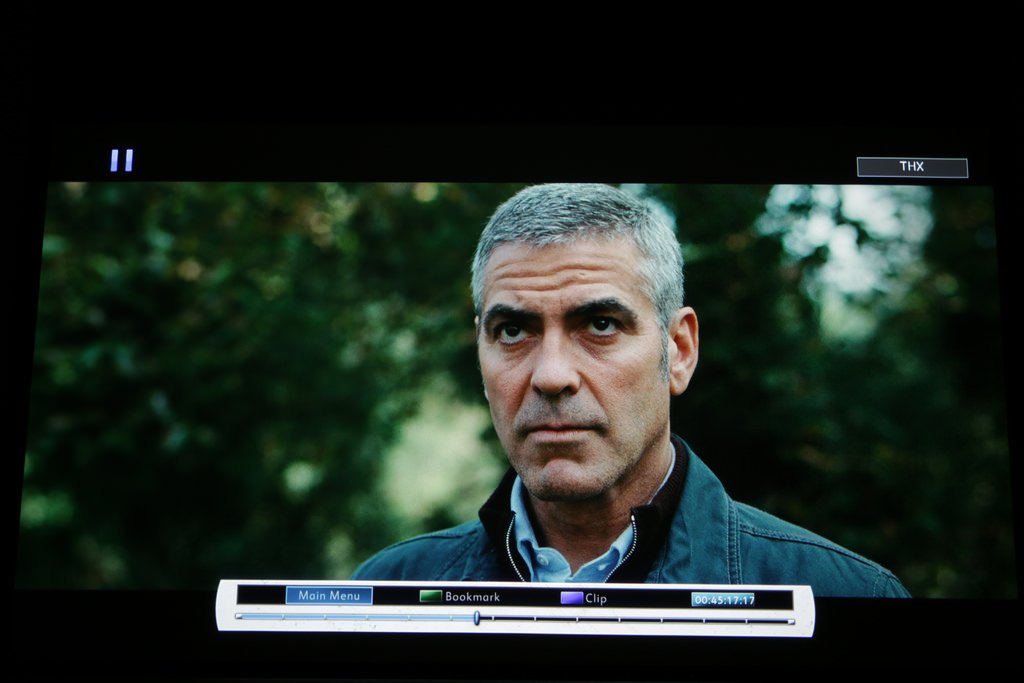
Screen shot below: JVC N7 in THX mode.
ADVANCED 8K/e-shiftX TECHNOLOGY
JVC has further developed its projection systems through the introduction of advanced optical pixel-shifting technology known as 8K/e-shiftX.
While the underlying D-ILA imaging panels maintain their native 4096 × 2160 resolution, selected premium models incorporate a high-speed optical shifting mechanism that increases the number of addressable pixel positions displayed on screen.
JVC's advanced 8K/e-shiftX system uses four-position pixel shifting. Through precisely controlled optical movement, each native 4K pixel contributes image information at four distinct positions. This produces a displayed resolution of: 8192 × 4320 — approximately 35.4 million pixel positions. The technology combines native 4K imaging with sophisticated image processing and high-speed optical shifting to reproduce exceptionally fine image detail.
Importantly, 8K/e-shiftX does not mean that the projector contains native 8K imaging panels. The system uses native 4K D-ILA devices to generate an enhanced 8K-resolution image through optical pixel shifting. JVC's DLA-NZ800 and DLA-NZ900 incorporate the second generation of this technology, known as Gen2 8K/e-shiftX.Other D-ILA models use native 4K projection without this additional 8K enhancement system.
BLU-Escent LASER ILLUMINATION
Modern JVC D-ILA projectors incorporate the company's proprietary BLU-Escent laser illumination technology.
This advanced laser-phosphor light source provides stable, high-output illumination while supporting precise control over projected brightness. Unlike traditional projector lamps, laser illumination does not require periodic lamp replacement and offers an extended operating lifespan.
JVC specifies laser light-source operating lives of approximately 20,000 hours under stated conditions for many of its premium models. Laser illumination also allows the projector to adjust light output dynamically according to the image being displayed. This provides additional flexibility in managing contrast, brightness and energy consumption.
Across JVC's current D-ILA home cinema range, manufacturer-specified brightness varies by model:
- DLA-NZ500: 2,000 lumens
- DLA-NZ700: 2,300 lumens
- DLA-NZ800: 2,700 lumens
- DLA-NZ900: 3,300 lumens
These figures represent rated projector light output rather than brightness measured at the projection screen.
Actual screen brightness depends on image size, screen gain, optical settings and projector calibration.
FRAME ADAPT HDR & DYNAMIC TONE MAPPING
High Dynamic Range (HDR) has introduced significant improvements in the reproduction of brightness, colour and image detail. However, HDR content is often mastered for display devices capable of producing substantially higher peak brightness than conventional projection systems.
To address this challenge, JVC developed Frame Adapt HDR, an advanced dynamic tone-mapping system designed to optimise HDR reproduction for the capabilities of the projector. Rather than applying a single fixed brightness adjustment across an entire film, Frame Adapt HDR analyses image information and adjusts tone mapping according to the content. This allows the projector to manage bright highlights, midtones and shadow information more effectively.
The second generation, Frame Adapt HDR Gen2, introduces further refinements to tonal reproduction and contrast management.
Selected JVC models also incorporate additional functions such as Deep Black Tone Control and Theatre Optimiser. These systems work together to improve the reproduction of demanding HDR material while preserving natural image detail. The result is a more balanced HDR presentation across a wide variety of cinematic content.
EXCEPTIONAL IMAGE SMOOTHNESS & PIXEL STRUCTURE
Another important characteristic of D-ILA technology is its extremely fine pixel structure. The reflective liquid crystal imaging panels feature very small gaps between adjacent pixels, producing a high pixel fill factor. This reduces the visibility of individual pixel boundaries and contributes to a smooth, continuous projected image.
On large cinema screens, this characteristic helps preserve the natural appearance of fine textures, facial detail and subtle image gradients.
When combined with native 4K resolution and high-quality optical components, D-ILA technology can reproduce exceptionally detailed images without an overly pronounced digital pixel structure. This makes it particularly well suited to dedicated home cinema installations where viewers are seeking a natural, film-like presentation.
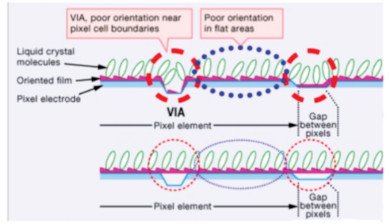
JVC’s D-ILA cells currently measure from 3.8 to 8 microns in size and the fill factor is over 93%. In addition, the company has developed a technique that purports to control the liquid crystal molecules floating in the gaps between cells to virtually eliminate any screen-door effect. Impressive!

ADVANCED OPTICS & PRECISION LENS SYSTEMS
The projection lens plays a critical role in determining the quality of the final image. Even the most sophisticated imaging panels depend on high-quality optics to accurately transfer their detail onto the projection screen.
JVC's premium D-ILA projectors incorporate precision-engineered lens assemblies designed to maintain sharpness, focus and image uniformity. Selected models feature large-diameter, all-glass lens systems with motorised zoom, focus and lens shift. These features provide installation flexibility while allowing the projector to maintain accurate image geometry. High-quality optics also contribute to consistent sharpness across the screen, reducing unwanted softness towards the outer edges of the projected image.
The combination of native 4K imaging panels and precision optical engineering is fundamental to achieving the full potential of D-ILA projection technology.
SMOOTH MOTION & ADVANCED VIDEO PROCESSING
Modern JVC D-ILA projectors incorporate sophisticated video processing systems designed to optimise image detail and motion reproduction. Selected models feature Clear Motion Drive, a frame-interpolation system that analyses moving images and generates additional frames to improve perceived motion smoothness. This can be particularly beneficial when viewing fast-moving sporting events or other high-motion content. Additional motion-processing features may also be available depending on the projector model.
For traditional cinematic material, viewers can adjust or disable motion interpolation to preserve the original frame cadence and appearance of the film.
Overall motion performance depends on the projector's imaging response, processing system, incoming frame rate and selected picture settings.
PRECISE PANEL ALIGNMENT & IMAGE ACCURACY
Because D-ILA technology uses three individual imaging panels, accurate alignment of the red, green and blue images is essential. JVC's optical systems are designed to maintain precise panel registration, ensuring that the individual colour components combine accurately on screen. Selected models also provide electronic pixel-adjustment functions to compensate for small variations in convergence. When correctly configured, the system produces clean image edges, excellent colour registration and consistent fine detail.
Accurate installation, lens adjustment and projector calibration are important factors in achieving the best possible results.
LONG-TERM PERFORMANCE & RELIABILITY
JVC's D-ILA projection systems are designed for demanding home cinema applications. Modern imaging panels, advanced thermal management and sophisticated laser illumination systems contribute to consistent performance over extended operating periods. The adoption of solid-state laser light sources eliminates the need for conventional lamp replacement while providing precise control over illumination.
However, the longevity of any projection system depends on several factors, including ventilation, operating temperature, environmental conditions and general maintenance. Appropriate installation and periodic servicing remain important to maintaining image quality and reliable operation.
LCD PROJECTOR TECHNOLOGY
Brilliant Colour. Advanced Imaging. Exceptional Cinematic Detail.
Liquid Crystal Display (LCD) projection technology has become one of the most established and widely used imaging systems in modern home cinema.
Through continuous technological development, LCD projection has evolved from traditional high-definition systems into sophisticated 4K-enhanced laser projectors capable of producing exceptionally detailed images, vibrant colours and impressive cinematic brightness.

One of the leading developments in this field is Epson's 3LCD technology, which uses three separate liquid crystal imaging panels to reproduce the red, green and blue components of an image simultaneously. By combining advanced optical engineering, precise liquid crystal control and sophisticated digital image processing, modern 3LCD projectors deliver excellent colour reproduction, natural image detail and a highly immersive viewing experience.
THREE-CHIP 3LCD IMAGING TECHNOLOGY
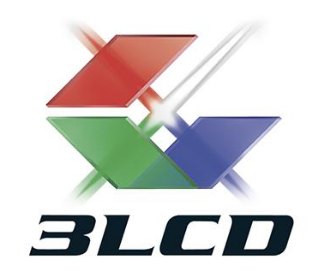
At the heart of Epson's 3LCD projection system are three individual liquid crystal imaging panels. Light from the projector's illumination system is separated into three primary colours: red, green and blue. Each colour passes through its own dedicated LCD panel, where millions of individual liquid crystal elements precisely regulate the amount of light transmitted through each pixel. The three images are then recombined through an optical prism to create the complete full-colour image projected onto the screen.
Because all three primary colours are displayed simultaneously, 3LCD technology delivers continuous full-colour images with excellent colour brightness and natural tonal reproduction. This three-chip optical arrangement is fundamental to Epson's approach to high-performance home cinema projection.
EXCEPTIONAL COLOUR BRIGHTNESS & ACCURACY
One of the defining characteristics of 3LCD technology is its ability to reproduce bright, vibrant colours while maintaining excellent overall image brightness. By simultaneously projecting red, green and blue light, the system can maintain strong colour light output alongside white light output. This is particularly beneficial when displaying colourful cinematic content, including landscapes, animation, sporting events and high-dynamic-range material.
Modern Epson 3LCD projectors also incorporate advanced colour processing, allowing accurate reproduction of subtle colour variations, skin tones and fine tonal gradations. When properly calibrated, these systems can deliver highly natural images that closely reflect the creative intent of the original material.
ADVANCED 4K PIXEL-SHIFTING TECHNOLOGY
One of the most significant developments in modern LCD projection is the introduction of advanced pixel-shifting technology. Rather than relying exclusively on the native resolution of the LCD imaging panels, pixel shifting uses extremely precise optical movement to reposition projected pixels at high speed. This allows additional image detail to be reproduced on screen, increasing the effective displayed resolution beyond the native pixel count of the LCD panels. Epson has developed different generations of this technology, including two-position and four-position pixel-shifting systems.
TWO-POSITION PIXEL SHIFTING
Earlier Epson 4K Enhancement systems use two distinct pixel positions to increase displayed image detail. A native Full HD LCD panel contains approximately 2.07 million pixels. By displaying image information at two slightly offset positions, the projector produces approximately 4.15 million pixel positions on screen. This improves perceived sharpness, reduces visible pixel structure and allows the projector to reproduce additional detail from higher-resolution source material.
FOUR-POSITION PIXEL SHIFTING
More advanced Epson 4K projection systems use four distinct pixel positions. Through extremely rapid and precisely controlled optical shifting, each native Full HD pixel contributes image information at four separate positions. This produces approximately 8.3 million addressable pixel positions on screen, corresponding to the pixel count of a 3840 × 2160 UHD image. The technology allows projectors equipped with native 1920 × 1080 LCD panels to reproduce a full 4K UHD pixel count on screen without requiring native 4K LCD panels.
Importantly, this is genuine optical pixel shifting rather than simply enlarging a Full HD image through digital scaling. However, pixel-shifted 4K and native 4K imaging are different optical approaches, and their ability to resolve extremely fine detail can vary.
EPSON'S MODERN 4K PROJECTION SYSTEMS
Projectors such as the Epson EH-LS9000B and EH-QL3000 employ advanced 4K enhancement technology capable of displaying approximately 8.3 million pixels on screen. These systems combine precision optical shifting with sophisticated image processing to reproduce highly detailed UHD content. The result is excellent image definition, smooth pixel structure and impressive clarity across large projection surfaces.
HIGH BRIGHTNESS & LASER ILLUMINATION
Modern LCD projectors have benefited enormously from advances in laser illumination technology. Traditional projector lamps are increasingly being replaced by sophisticated laser light sources capable of delivering consistent illumination, rapid start-up and extended operating life.
Epson's premium 3LCD laser projectors combine their three-panel imaging architecture with advanced laser light engines to produce substantial colour and white brightness. For example, the Epson EH-LS9000B delivers a specified 2,200 lumens of colour and white light output, while the EH-QL3000 is designed for considerably larger installations with a specified output of 6,000 lumens.
These brightness capabilities allow LCD projection technology to accommodate a wide range of screen sizes and viewing environments. As with any projection system, actual on-screen brightness depends on projector calibration, image size, screen gain and installation conditions.
CONTRAST, BLACK LEVELS & IMAGE DEPTH
Modern LCD projection systems are capable of reproducing impressive contrast, detailed shadow information and excellent image depth. The individual liquid crystal panels regulate transmitted light to control the brightness of each pixel, while advanced laser illumination and dynamic contrast systems provide additional control over the overall image. This combination allows premium LCD projectors to reproduce detailed highlights, subtle shadow gradations and natural transitions between light and dark scenes.
Epson's advanced home cinema models also incorporate sophisticated image processing designed to optimise contrast and tonal reproduction. However, it is important to distinguish between native contrast and dynamic contrast.
Native contrast describes the imaging system's inherent ability to reproduce differences between black and white without dynamic light-source adjustments.
Dynamic contrast incorporates additional light-output management and can produce substantially higher published contrast figures. Both contribute to the viewing experience, although they describe different aspects of projector performance.
SMOOTH MOTION & ADVANCED IMAGE PROCESSING
Modern 3LCD projectors employ sophisticated digital processing to reproduce smooth, detailed motion. Advanced image processors analyse incoming video signals and optimise image sharpness, colour, contrast and motion characteristics. Selected Epson home cinema projectors also incorporate frame interpolation technology. This process analyses consecutive video frames and generates intermediate frames to improve perceived motion smoothness.
Some screen captures using Epson TW9400

The Epson TW9400, to everyone's surprise, had an ANSI-contrast of 480:1.
Frame interpolation can be particularly beneficial for sporting events and other fast-moving content. For traditional cinematic material, viewers may prefer to reduce or disable interpolation to preserve the original motion characteristics of the film. The choice ultimately depends on the content and individual viewing preferences.
PRECISE PANEL ALIGNMENT & IMAGE UNIFORMITY
Because 3LCD technology uses three separate imaging panels, accurate alignment of the red, green and blue images is essential. Premium projector designs incorporate precision optical assemblies to maintain accurate panel registration and consistent image geometry. Some models also provide electronic panel-alignment adjustments to compensate for small variations in colour convergence. When correctly aligned, the three-panel system produces sharp images with natural colour reproduction and excellent detail.
Image uniformity also depends on the quality of the projection lens, optical assembly and installation.
High-quality glass optics play an important role in maintaining focus, sharpness and consistent image performance from the centre of the screen to its outer edges.
LONG-TERM PERFORMANCE & RELIABILITY
Modern 3LCD projection systems are designed to provide consistent image performance over extended operating periods. Advances in liquid crystal materials, optical cooling, thermal management and laser illumination have significantly improved the durability of contemporary LCD projectors. Premium Epson laser models feature solid-state light sources with specified operating lives of up to 20,000 hours under stated conditions.
Unlike traditional lamp-based systems, these laser projectors do not require periodic lamp replacement. However, overall projector longevity still depends on environmental conditions, ventilation, operating temperatures and the condition of optical and electronic components.
Appropriate installation and regular maintenance remain important to preserving long-term image quality.
DLP PROJECTOR TECHNOLOGY
Precision Engineering. Exceptional Clarity. Cinematic Performance.
Digital Light Processing (DLP) is a sophisticated projection technology designed to deliver exceptional image sharpness, precise detail and outstanding motion performance.
At the heart of every DLP projector is a Digital Micromirror Device (DMD), a remarkable semiconductor chip containing hundreds of thousands or millions of microscopic mirrors. Each mirror represents an individual image pixel, tilting at extremely high speeds to precisely control the light reflected towards the projection screen. The result is a highly detailed image with excellent pixel definition, smooth motion and impressive visual consistency.
EXCEPTIONAL IMAGE SHARPNESS & DETAIL
One of DLP technology's greatest strengths is its ability to produce exceptionally crisp, well-defined images. The microscopic mirrors are positioned extremely close together, creating a high pixel fill factor with minimal visible gaps between pixels. This produces smooth, detailed images with excellent edge definition and reduced screen-door effect.
When paired with a premium projection screen, DLP technology can reproduce intricate textures, fine architectural details and stunning cinematic imagery with remarkable clarity.
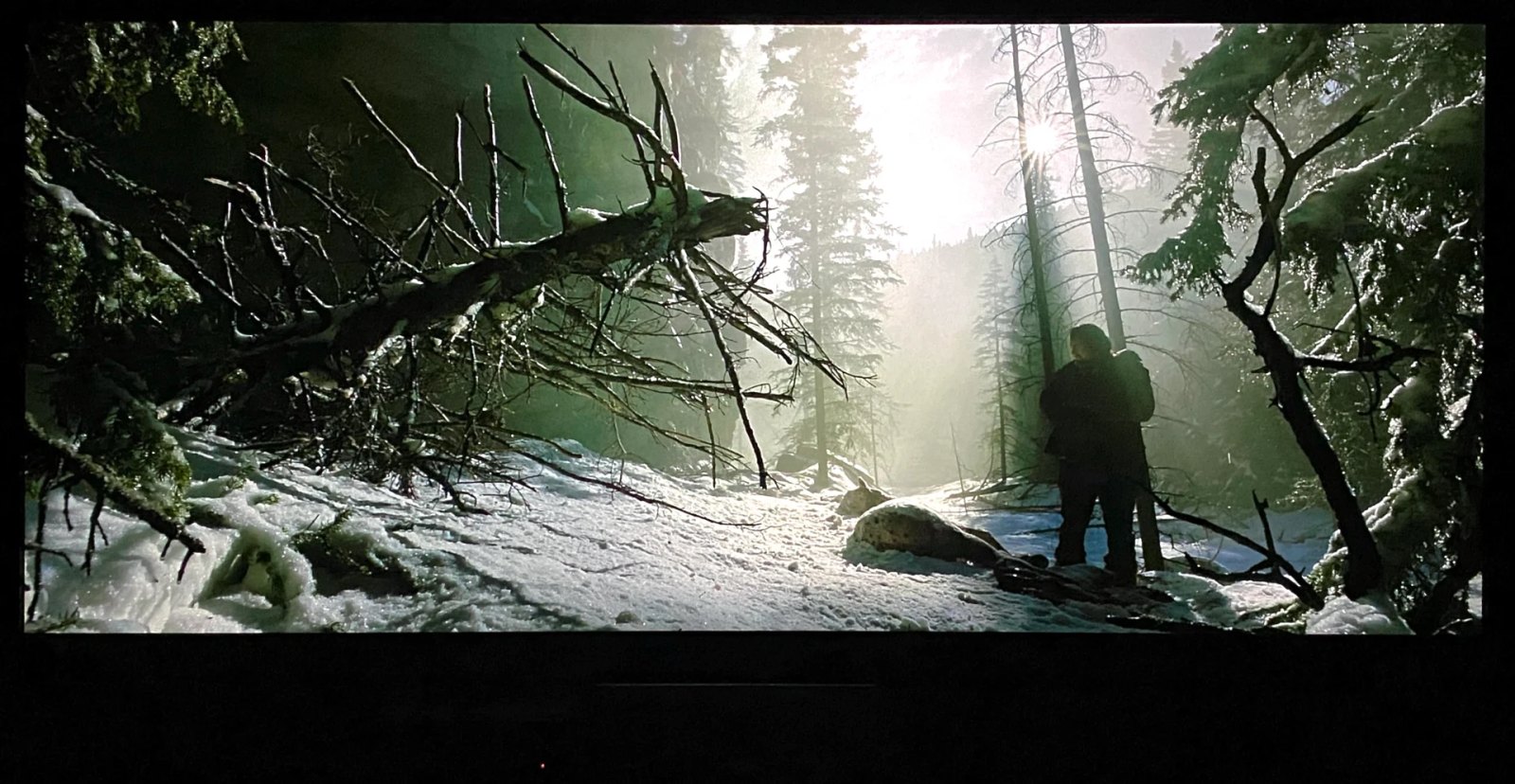
Screen shot below from a 1080P BenQ W5000.

FAST RESPONSE & SUPERIOR MOTION CLARITY
DLP technology is particularly well suited to fast-moving visual content. Unlike traditional liquid crystal imaging systems, DLP's microscopic mirrors can change position in microseconds, allowing extremely rapid modulation of light. This fast response contributes to excellent motion clarity, particularly during action sequences, sporting events and high-speed gaming. However, overall gaming input lag also depends on the projector's video processing and electronics, rather than the DLP chip alone.
CONTRAST, BLACK LEVELS & IMAGE DEPTH
DLP projectors are capable of producing impressive contrast, vibrant highlights and excellent image depth. Their precise light control helps reproduce subtle variations in brightness, giving projected images a natural sense of dimension and realism. However, black-level performance varies considerably between projector models.
While premium DLP systems can deliver excellent cinematic contrast, competing technologies such as D-ILA and certain LCD-based systems can achieve significantly deeper native black levels.
The final result depends on the projector's optical design, light source, contrast management and the viewing environment.
COMPACT & EFFICIENT OPTICAL DESIGN
One of the advantages of single-chip DLP technology is its relatively compact optical architecture. By using a single imaging chip rather than three separate imaging panels, manufacturers can produce projectors with smaller, lighter and more streamlined designs. This makes DLP suitable for everything from compact home entertainment projectors through to sophisticated dedicated cinema installations.
Larger professional DLP systems may employ three separate DMD chips for enhanced colour performance and brightness.
PRECISE PIXEL ALIGNMENT
Single-chip DLP technology offers an important advantage when it comes to image alignment. Because the image is generated using a single DMD chip, there is no requirement to mechanically align three separate red, green and blue imaging panels. This eliminates the panel-convergence errors that can occasionally affect three-panel projection systems. The result is consistent pixel alignment, clean edges and excellent image definition across the projected image.
DLP systems can also benefit from sealed optical designs that help protect sensitive imaging components from airborne dust, although this depends on the individual projector.
LONG-TERM PERFORMANCE & RELIABILITY
DLP technology is renowned for the durability and stability of its microscopic mirror system. Unlike liquid crystal imaging panels, DMD chips do not rely on liquid crystal materials to modulate light. Their electromechanical design provides excellent resistance to many forms of image degradation, supporting consistent performance over extended operating periods.
As with all projection technologies, long-term reliability also depends on thermal management, optical components, the light source and general maintenance.
Calibration discs
Highly recommended calibration discs with test patterns to set your brightness, contrast, sharpness and many other features. Stacey Spears and Don Munsil, acclaimed creators of the Spears & Munsil High Definition Benchmark Blu-ray Disc, released the HD Benchmark 2nd Edition. The first edition was recommended by the New York Times, Widescreen Review, Secrets of Home Theater and High Fidelity and many other print and online publications. The second edition adds even more features and patterns and sets a new bar for the term “state of the art”. See their website for more detailed information.